The Pleasure of Keeping a Small Collection
A small collection becomes more rewarding when its theme is clear and its differences are easy to notice, without pressure to complete every set.
The most common mistake in keeping a small collection is treating it like a set that must be completed. That pressure can turn a pleasant search for old postcards, matchbooks, or buttons into a costly hunt for the one missing piece. A small collection is more satisfying when its limits help you notice what is already in your hands.
Keeping a small collection does not mean collecting carelessly. It means choosing a theme narrow enough to guide your attention, then letting differences between objects provide the interest. When collecting starts to feel like a race, a few practical adjustments can bring back the pleasure.
Give a broad collecting theme a useful boundary
“Old things” or “souvenirs” can include nearly anything, so each new object asks you to make the same decision again. An open-ended theme can make browsing feel like an obligation: if an item fits vaguely, you may feel you ought to keep it.
Choose a boundary you can explain in one sentence. You might collect postcards showing public gardens, paper tickets from local music venues, or souvenir spoons from places you have visited. A clear theme narrows the field without requiring every object to look alike.
Try boundaries based on subject, material, place, or a question you enjoy asking. “Printed maps of neighborhood parks” gives you a practical filter; “interesting paper” does not. You can revise the boundary later, but begin with one that makes ordinary browsing easier.
Compare one feature when new objects look interchangeable
A collection can feel dull even when it grows, especially if every addition seems to repeat the last. The cause is often not a lack of rare finds. It is that the objects are being grouped without a reason to look closely.
Pick one feature to compare: the lettering on matchbooks, the colors used on postcards, the shape of ticket stubs, or the way a maker marked a button. You do not need specialist knowledge. A magnifying glass, a notebook, or a phone camera can help you notice details that were easy to miss at first glance.
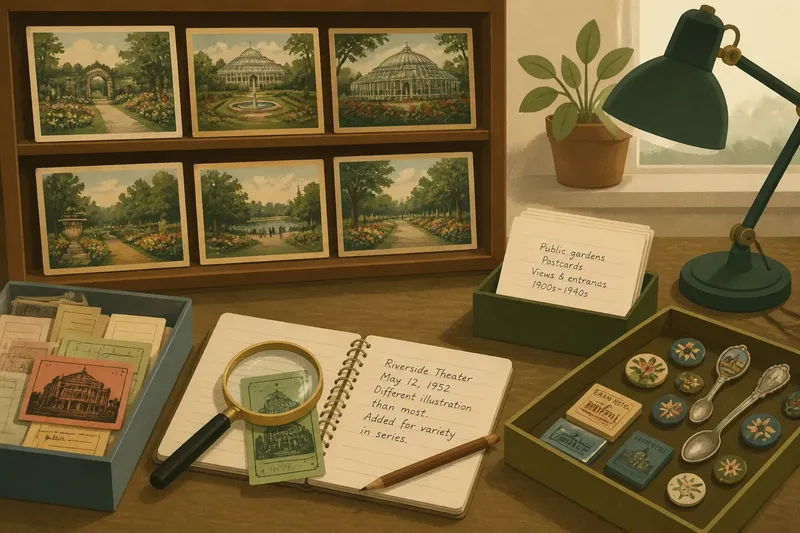
Say you collect postcards of public gardens and notice that some show a formal entrance while others focus on a greenhouse. You could sort them by view and write a short note about what each image emphasizes. The expected result is a small display that makes the differences visible, even if the postcards came from familiar places.
Change the stopping rule when completeness takes over
Sets and numbered series can make collecting feel like a race. A missing item becomes more prominent than the pieces you already enjoy, and the hunt can crowd out the original reason you started. This is especially common with products designed to be collected as a complete series.
Decide what “enough” means before you browse. You could stop at objects from a particular neighborhood, keep only examples that teach you something new, or set aside a defined shelf or box. A stopping rule is not a promise never to change your mind; it is a way to keep each addition deliberate.
For items sold as a series, treat the printed numbering as information rather than a command. If you like the illustrations or packaging, collect the ones that appeal to you and leave the rest. The collection can tell a coherent story without containing every issue.
Make a collection easier to revisit
Objects tucked into drawers can become out of sight and out of mind. Poor storage can also make handling awkward: paper may bend, small pieces may scatter, and labels may drift away from what they describe.
Use storage suited to the material. Acid-free sleeves or folders can help keep paper items together; shallow trays can separate small, sturdy objects; a simple index card can record where a piece came from or why you kept it. Keep notes brief and factual, such as a location, maker’s mark, or detail you want to remember.
Make a small display only if it suits the objects and the space. A rotating selection in a frame, on a shelf, or inside a glass-fronted cabinet lets you enjoy pieces without putting everything on view. Keep the remaining items organized so you can bring them out when curiosity returns.
Pause before buying another object
Repeated purchases can happen because an object is inexpensive, familiar, or presented as a rare chance. The result may be a pile of near-duplicates that takes up room without adding a new point of interest.
Before buying, ask whether the piece fits your theme, shows a difference you care about, or fills a role in how you want to display the collection. If none applies, take a photo or note the detail that caught your eye and leave the object where it is. You can appreciate a design without owning it.
Imagine you collect local theater tickets and see a stack at a flea market. The hypothetical starting point is a group of tickets from the same venue, with most showing the same format. You compare their designs, select one with a noticeably different illustration, and leave the near-duplicates behind. The result is one addition that contributes a new visual detail, while the tradeoff is passing up other tickets that might have been appealing on their own.
- Check whether the object fits the theme you can explain in one sentence; if it does, consider it, and if it does not, leave it out or revise the theme deliberately.
- Check whether it shows a detail not already represented; if it does, keep or buy it only if that difference interests you, and if it does not, take a note or pass.
- Check whether the item belongs to a series you feel pressured to complete; if the individual piece appeals to you, choose it on its own merits, and if not, leave the series unfinished.
- Check whether you have suitable storage for its material; if you do, place it with related objects, and if you do not, wait or choose a safer storage option before adding it.
- Check whether you can identify where the object came from or why it matters to you; if you can, record that note, and if you cannot, decide whether its visible qualities are enough reason to keep it.
- Check whether the collection still feels enjoyable to browse; if it does, continue at a deliberate pace, and if it feels like a chore, pause purchases and edit or reorganize what you have.
What should a small collection include?
How narrow should a collecting theme be?
Make it narrow enough that you can quickly say what belongs, but not so narrow that every addition must be a specific missing item. For example, “postcards of public gardens” allows variety in place and viewpoint while giving you a clear reason to decline unrelated cards.
Do I need to collect every item in a series?
No. A series can offer a convenient organizing idea, but it does not set an obligation. Keep the pieces you find appealing or informative and let the rest remain outside your collection.
How can I make a collection interesting to look at?
Arrange objects around a visible difference, such as color, location, shape, or subject. A small label or note can explain the connection without turning the display into a catalog.
When should I stop adding to a collection?
Pause when new objects no longer give you something to notice, or when storage and browsing feel like chores. You can keep the collection as it is, refine its theme, or let it rest without treating that choice as failure.
Keep the collection small enough to enjoy
A small collection can hold a lot of attention when each object earns its place through a detail, a connection, or a memory of where you found it. The pleasure of keeping a small collection comes less from reaching a final count than from seeing familiar objects with sharper eyes.
If the collection begins to feel crowded, take out a few pieces and ask which differences you would miss. That simple edit can clarify the theme, make the remaining objects easier to revisit, and leave you room to keep collecting at your own pace.