Board Games That Get Everyone Playing Without a Long Teach
Choose board games with rules you can teach in a minute by focusing on clear goals, visible turns, and a teach that leaves room for questions.
The common mistake with board games with rules you can teach in a minute is treating that phrase as a promise about the clock. A rushed explanation can leave players unsure what to do, while a long speech can drain the energy from a casual gathering. Look instead for a game whose first turn is easy to show, then teach only what people need to begin.
Board games with rules you can teach in a minute depend on a clear first turn
A quick-entry game gives players a recognizable goal and a small set of actions they can see or try. That does not mean every detail fits into a fixed time. A question about a card or symbol may still come up, and the host should leave space for it rather than racing through the rules.
Before choosing, check the rulebook for the objective, the opening turn, and the end condition. Then look at the components: cards with clear effects, a simple board layout, or a player aid can make the explanation more concrete. The box description alone may not reveal how much people need to remember before their first move.
More involved games can be a good fit when guests have set aside attention for learning together. They may ask players to manage several options or remember how different systems interact. If people are arriving at different times or splitting their attention between dinner and conversation, that complexity can make the opening feel like a lesson rather than play.
Choose a game around the evening’s attention
Think about what else will compete for the table’s focus. A meal, a lively conversation, children moving in and out of the room, or a late guest can all change how much explanation feels comfortable. A quick-entry game can help people join without waiting for a full group, while a layered game is easier to teach when everyone can stay for the opening.
Ask guests what kind of evening they want rather than guessing. A brief message such as “Would you rather start with something easy to pick up or learn a game together?” gives people a real choice. Keep the plan flexible: if the group is still chatting when they arrive, start with a game that tolerates interruptions; if everyone is ready to focus, bring out the deeper one.
Prepare a teach that leads directly to a move
Set up the game before explaining it, and keep the rulebook or player aids within reach. Start with the goal, show what happens on a turn, and explain how play ends. Point to the actual cards, spaces, or tokens as you speak; a visible example is easier to follow than a list of symbols recited from memory.
Explain any choice that could cause confusion or cannot easily be undone before someone makes it. Save less urgent exceptions for the moment they matter, then check the rulebook together. If you need several minutes of background before anyone can take a turn, say so plainly and ask whether the group wants that kind of game tonight.
For a more involved game, explain the broad aim and the first few choices, then demonstrate one turn from start to finish. Keep the rulebook open to the relevant page and let players ask questions as they go. A group can agree to treat the opening round as practice, provided everyone understands that early decisions are part of learning.
Check the teach before deciding to play
- Objective: If you can state the goal in one clear sentence, start with that game; if the goal needs several conditions, choose a simpler option or explain those conditions before setup.
- Opening turn: If a turn can be shown with the components on the table, demonstrate it; if it requires several rules to make sense, offer the game only to a group ready for a longer teach.
- Rulebook layout: If setup, turn order, and end condition are easy to locate, keep the book nearby for questions; if you cannot find them quickly, review the instructions first or select another game.
- Late arrivals: If someone may join after play starts, pick a game where a new player can enter without missing essential setup; if the rules depend on an opening sequence, wait for everyone or save it for another night.
- Group attention: If guests are settling in and listening, explain the first turn; if conversation keeps interrupting, start with a game that can pause easily or let people finish chatting first.
- Irreversible choices: If a first move spends a shared resource or takes a limited card, explain that consequence before play; if choices are easy to correct, let players learn by trying and clarify as needed.
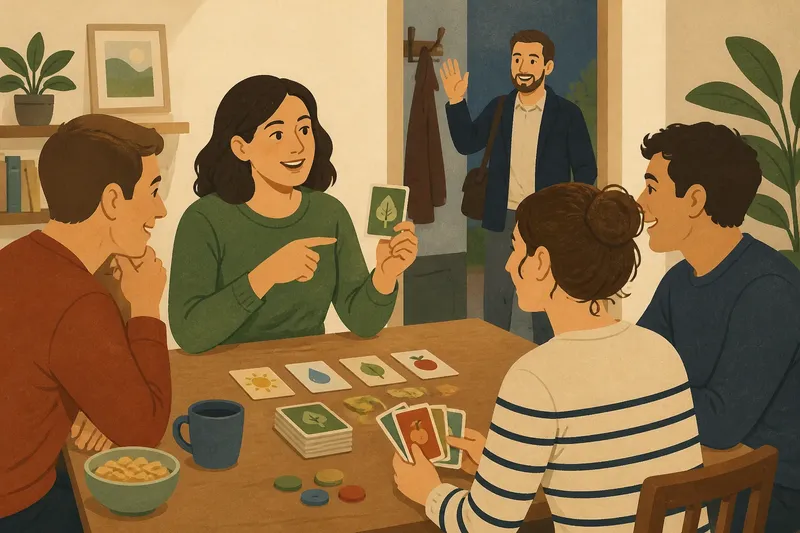
Say you have invited four neighbors for dinner, and one may arrive after the meal. You have a card game with a clear goal and a strategy game whose first round relies on everyone being present. You set up the card game and explain its goal and turn, then begin while the late guest is still on the way. Once everyone has arrived, you ask whether the group wants to continue with another round or hear the strategy game’s longer explanation. The observable result is a start that does not leave the late guest behind, with the more involved option still available if the group wants it.
What makes a short teach work for this group?
What makes a board game easy to teach?
A clear goal, a repeatable turn, and components that help show what happens make a game easier to explain. Players can begin with the main loop in mind and learn smaller exceptions when they arise.
When should you choose a more involved game?
Choose one when guests want to focus and have time to learn together. A returning group may enjoy a system with more choices, while a distracted or mixed-arrival crowd may prefer a quicker start.
What should you do if the explanation keeps growing?
Pause and separate what players need for the first turn from rules that matter later. If the opening still feels unclear, switch to a simpler game or ask the group whether they want to continue learning.
Can a newcomer join a game with layered rules?
Yes, if the newcomer wants to learn and the group is comfortable pausing to explain decisions. Show a sample turn, offer a player aid, and make it clear that questions are welcome.
Let the game fit the gathering, not the other way around
A short teach can serve as the whole evening or give guests an easy way to settle in before a longer game. A layered game can be the main event for a group that has chosen to concentrate. Neither choice says anything about how serious or skilled the players are; it simply reflects the kind of attention they want to give the table.
When choosing board games with rules you can teach in a minute, treat the phrase as a description of an accessible start, not a stopwatch target. Read the exact setup and exceptions, show the first move, and listen for whether the group wants more. If the answer changes after the first round, it is perfectly reasonable to change games too.